
I ran into Shammas at the Art Expo in Hardesty Park.
My political friends all ask, in a slightly hushed tone, “How are you doing?”
They know what it’s like to lose, especially for a person who is driven and competitive.
My loss for my run at city council barely registers in my mind any more. I’m honestly just as happy that I didn’t win. That loss allows me to stay focused on my true passion: sheltering the hardest to shelter homeless people.
We had a good talk. I confirmed that his plan is to focus on education and safety. By every measurable account of society, education and safety allow for the greatest advancements in a community. Education is the absolute best way to break the cycle of poverty and hopelessness. Nothing levels a playing field better than education. Safety makes education and everything else possible.
I asked him if he’d be open to talking about homelessness. He said he would. That’s all I can ask.
My next writing venture is a booklet for how to handle homelessness in American cities. It will be a how-to guide for working with a wide spectrum of homeless people. The audience will be city councils, mayors and other city administrators. It will be written with Akron in mind. But the problems in Akron are the exact same problems in San Diego, Portland, Seattle. The only difference is scale.
I think the biggest problem we have with our homeless strategy is that we lump all these people into one or two huge categories. The average city administrator just thinks about “the homeless.” A nuanced city administrator will add a second category: “chronically homeless.” And then that’s it. They say something about addiction and mental illness and that’s the long and short of the conversation.
Just off the top of my head, here are some subcategories of homeless people:
First there is the category or income, government assistance and identification.
People with disability checks, social security checks or veterans assistance.
People with no government income.
People with food stamps.
People with health care.
People with no government assistance at all.
People with all 3 forms of ID: birth certificate, ID and social security card.
People with 1 form of ID.
People with no form of ID.
If you have a person getting $850/month or more you have so many more options than a person who gets no income. And by “so many more options” I mean you can maybe get someone to illegally let you sleep in their basement or garage. Maybe you can get into some subsidized housing if you have the mental and emotion capability to jump through those hoops.
But for mentally disabled people or seriously mentally ill people or people who would rather just stay on the street, all these items amount to almost nothing. The dope boy is much smarter and cunning and ruthless than you. The dope boy gets most of these checks. They know when the money hits the card. They already are owed for last month’s drugs. That entire check will be gone within 3 days. The grocery stores get the rest of the money. I’ve seen homeless people buy lamb and other costly meats, expensive energy drinks, all kinds of pastries.
My friend Cadillac, who is going to be thrown out of our house on September 1, is not part of this group. He’s very good with his money. He saves and budgets. But I think the system is overwhelming for him. The thought of calling on apartments, paying the $45 application fee, filling out the paperwork, getting turned down. It’s all too much. So you have people like that too.
I go into several other categories of homeless people in my last book:
The isolated
The retired criminal
The black sheep
The schizophrenic
The fallen African American man
Randy (I dedicate one section all to my friend Randy who is quite happy living on porches and in tents. He got extremely claustrophobic spending a couple decades in the old Mansfield penitentiary. He doesn’t like small spaces.)
My experience has been that these subsections of homeless people think and behave differently than each other. And because of that they need to be worked with differently.
So, I’ve got all this foundational work to do. Then we can start thinking about the strategy for how to work with these people.
But let me stop right there. I have one HUGE goal for the first 4 years of the Shammas Malik administration. I would like to see 6 tiny houses in Akron for homeless people. I feel like that’s a doable goal. And if we got that done it would be a massive move forward in thinking about homeless people.
Shammas said that he was interested in tiny houses at a mayoral candidate debate. He even knew about the Pallet Shelter:
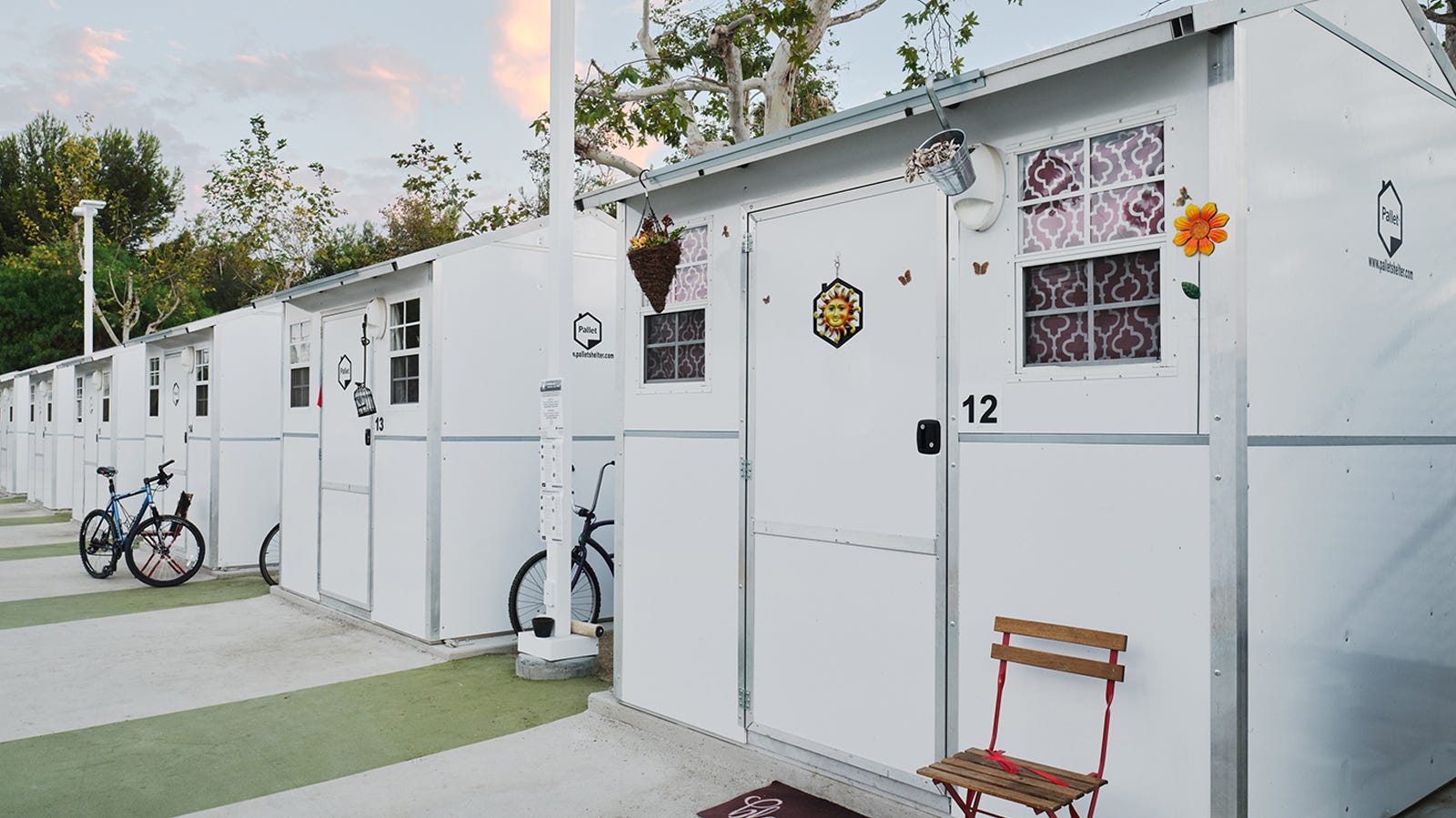
These units have heating and air conditioning. They cost about $7500 each.
I am very confident that I could fund all of this with private money. I just need a place for them to reside.
But here is the thing, I firmly believe you can’t just take random homeless people and put them in here. I believe you start with homeless people who are getting a check. You charge $250/month to live there. And they agree to go to mental health and addiction treatment. They also need to work the plan for getting into traditional housing.
If the person is actively doing those things then they can stay as long as they want. There cannot be a hard line of when someone has to leave these tiny houses. The system is a nightmare to navigate. And we all are moving through life at our own pace.
My friend Cadillac would be a PERFECT candidate for one of these tiny houses.
It is also crucial that there is 24 hour security and safety fencing. The residents of these tiny houses can come and go whenever and however they want. But guests must be closely monitored. Security cameras will also be very important. It is quite possible that people living in the community will steal from other community members.
Theft in the homeless community is constant. And it undermines any kind of progress a person is making. Proven theft will need to be an immediate removal from the community.
There is a very clear “crab in a bucket” mentality in the homeless community. People not in the tiny houses will actively try to undermine this entire program. If given the chance they will steal from these people and destroy whatever they can. For example, a wooden privacy fence might be better than a chain link fence because a lot of homeless people keep bolt cutters on their person for scrapping metal. So cutting through a chain link fence is very easy. Other homeless people will do anything in their power to pull these people back out of these tiny houses and get them back on the street.
I once saw a person burn down a tiny house made by a supporter just so the person living in it couldn’t have it.
I have been so fortunate to get to shelter a wide variety of homeless people in a wide variety of situations. I consider this the great honor of my life to be able to do this work. Along the way, I have learned quite a few things. The outline above comes from these learnings. But it is also crucially important to know that we must expect the unexpected. I’ve seen a lot. But I also see new things every single day.
If we can get this done in 4 years I will feel like we will have made incredible progress. I think this is something that Shammas Malik might be interested in. And I also think it would appeal to the liberal majority of people who support Shammas.
I believe that a community like this would teach us valuable insights about how to progress next.
That said, this is not the community of homeless people that call to me the most. The people in these tiny houses are actually ready to handle the stress and challenges of being in a structured shelter and community. These people are quite advanced in their homeless journey.
My next book might be called: “Wild Humans.”
These are the people who drive my passion. They have truly become feral. They are still very definitely human in every possible way. They are incredibly smart. They are cunning. They are good with their hands. But they have left society (or should I say, society has left them). They are wild. They are free. And they are going to take a completely different strategy if we want to invite them back into our society. We also have to be aware that it’s quite possible they will spend the rest of their lives living wild on the streets. If we ever want to consider ourselves to be a truly advanced civilization we must find ways to take care of these people who live amongst us in every city in America.
I’ll write more about my plans for them at another time.